A dollar. A dipstick. A diagnosis.
We built the world’s first urine dipstick for Riverblindness. No lab. No power. No excuses.
Diagnostics were built for hospitals with electricity. We build for everywhere else — a strip, a sample, and an answer while the patient is still in the room.
Africa doesn’t have a disease problem. It has a diagnosis problem.
The treatments exist. The drugs are cheap. What’s missing is the test that tells a health worker who needs them.
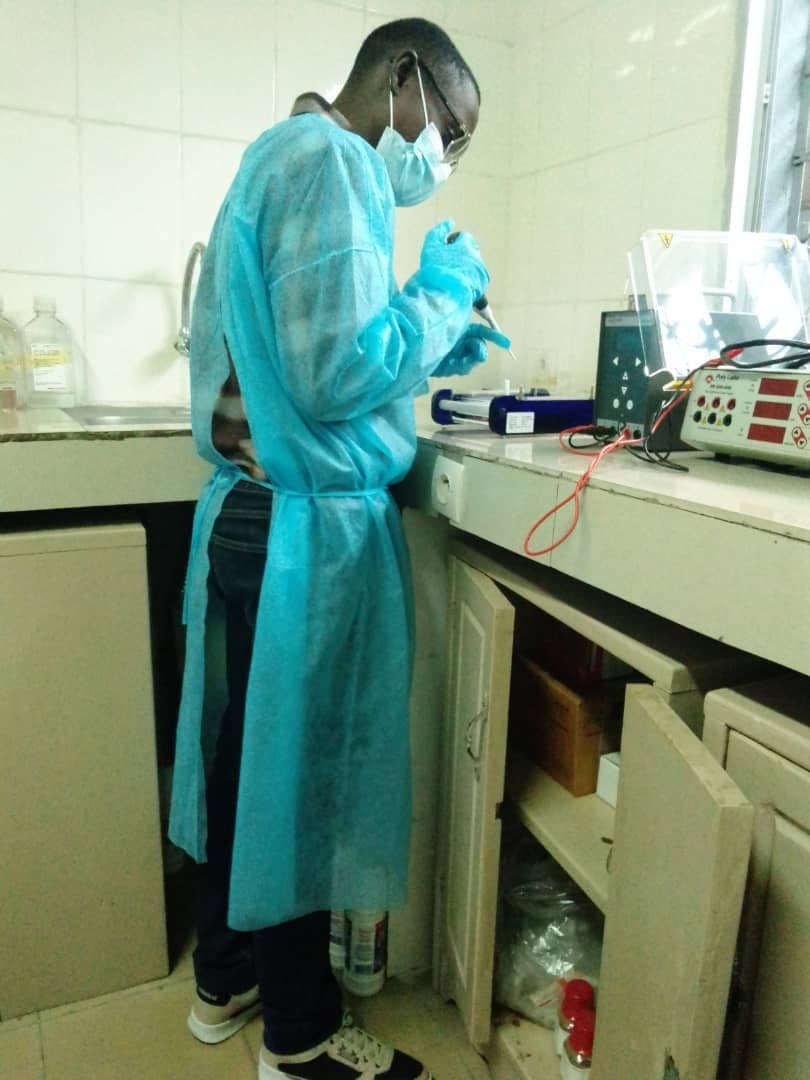
Today that test means a cold chain, a centrifuge, mains power and a trained technician — none of which exist in the villages where the disease actually is. So samples travel for days, results come back in weeks, and most people never get tested at all.
Diseases that are trivially treatable go undetected until they’ve already taken someone’s sight. That is not a science problem. It’s a distribution problem — and distribution problems get solved by making the thing cheap enough and simple enough to go everywhere.
So we put the lab on a paper strip.
RiverKit detects live Riverblindness infection from urine. No blood, no skin snip, no needle. A health worker dips the strip and reads the result — no power, no cold chain, no training.
It is the world’s first urine antigen-based dipstick for onchocerciasis, and we have taken it through proof-of-concept on two grants from the African Research Network for Neglected Tropical Diseases. The science is published.
Our target is under one dollar a test. At that price, testing stops being a programme someone has to fund and starts being something a clinic simply does.
One disease first. Then the next. Then every one we can reach.
Supported & backed by: